
Clinical CGM vs. OTC Glucose Sensor: Which One Actually Fits Your Midlife Weight Loss Goals?
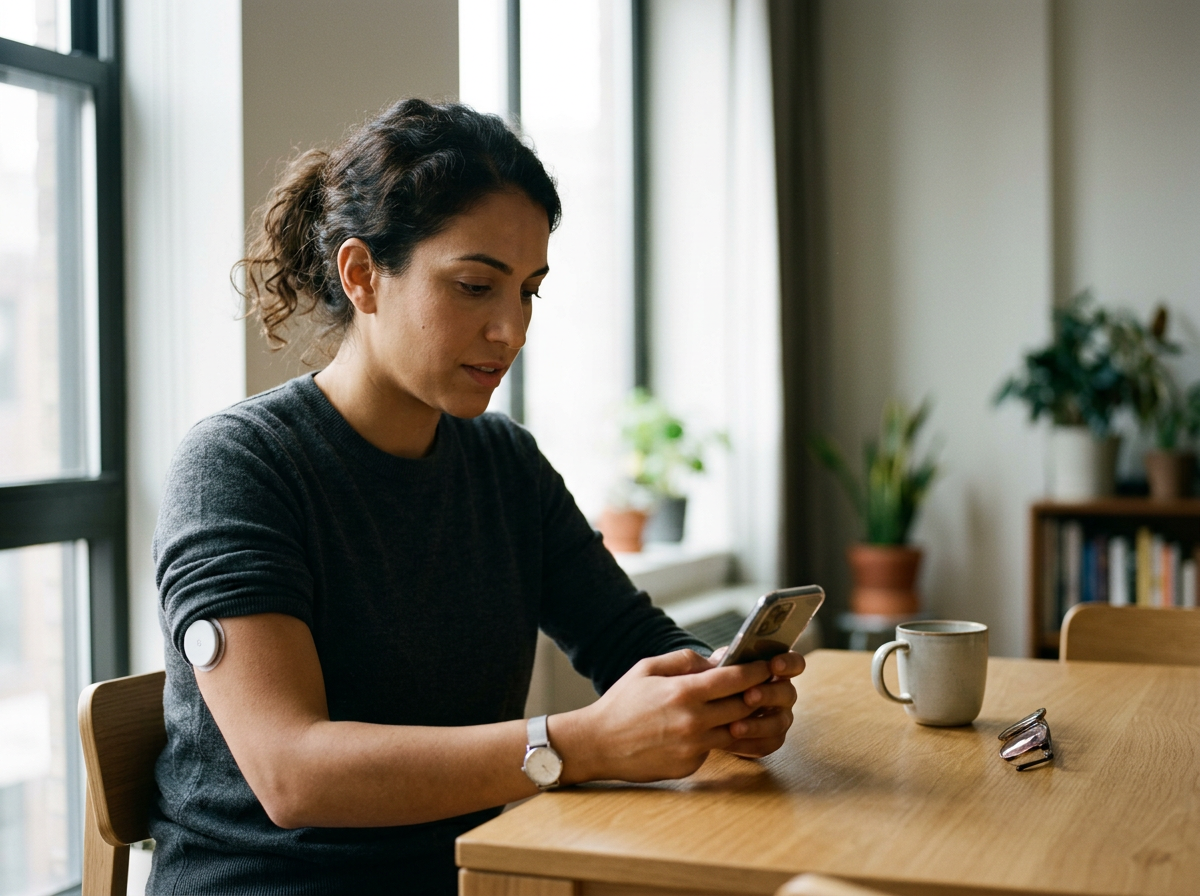
Friend, if you've started looking into continuous glucose monitors, you've probably noticed there's more than one option now — and they are not all the same thing.
I used to teach my own group coaching program with a simple finger-prick glucometer. One little poke, one drop of blood, one single snapshot of your blood sugar at one moment in the day. It worked. It gave women real information for the first time in their life about what was happening inside their bodies.
But here's an analogy I love: a single finger-prick check is like buying a house sight unseen, and your realtor sends you one photo — just one room. Would you buy that house off one picture? Of course not. That one room might look perfect, and the rest of the house could be falling apart. A continuous glucose monitor is different. It gives you the whole walkthrough. Every hallway, every room, morning, noon, and night.
That's the difference between OTC and clinical-grade too, just one level deeper — and it's worth understanding before you choose.
This post contains affiliate links, which means I may earn a small commission if you purchase through them, at no extra cost to you. I only recommend products I trust and use myself.
The Two Categories
Over-the-counter (OTC) sensors — like Stelo — are wellness devices. No prescription required, no clinical oversight, and priced to be accessible.
Clinical-grade CGMs — like the ones offered through Theia, which is what I recommend inside Insulin Insight for Midlife Weight Loss — are FDA-approved for accuracy and therapeutic decision-making. They're built for situations where the data itself is guiding a real plan, not just satisfying curiosity.
What Actually Matters When You're Choosing
Before we get into the side-by-side, here's what I want you paying attention to, friend — because a spec sheet won't tell you this part.
Will it actually be there when you need it? If a sensor falls off early or stops working, you shouldn't be stuck. A good CGM partner replaces it without a fight.
Does it capture your whole life, not just your food? Your blood sugar isn't only responding to what's on your plate. Sleep, stress, movement, supplements — all of it shows up in your numbers. You want a tool that lets you track more than just meals, because that's where the real patterns hide.
Can you actually see your trends, not just today's number? A single day tells you almost nothing. You need to be able to look back over a week or more and watch how your body responds over time — that's where the "insight" part happens.
Can your coach see what you see? This one matters more than people realize. If I can't see the same data you're looking at, in real time, I'm coaching you off guesses. The whole point of the program I lead is that we're looking at your actual numbers together.
Getting Started
Stelo wins for a quick start. It's easy to follow along and get going with almost no learning curve.
Onboarding with Theia is simple too, and honestly their support has been exceptional — their customer service team is great, and there's an AI assistant available 24/7 that answers questions the moment they come up. I've found that alone genuinely helpful, especially at odd hours when a question pops up and I don't want to wait until morning.
Side-by-Side: Stelo vs. Theia
| Stelo (OTC) | Theia (Clinical-Grade) | |
|---|---|---|
| Prescription required | No | Yes — Theia handles this for you |
| Accuracy standard | Wellness-grade | FDA-approved for therapeutic decision-making |
| Cost | $89/month or $99 one-time for 2 sensors | $99 activation + $99/sensor (~$297 first month, ~$198/month ongoing); $35/month BYO-sensor option |
| Data sharing with a provider | Limited | Built for real-time provider/patient sharing |
| Replacement policy | Standard | Guaranteed replacement if a sensor fails |
| FSA/HSA eligible | Yes | Yes |
Why the Accuracy Difference Matters
For years, weight loss was taught as counting calories in, calories out. But your body doesn't run on math. It runs on hormones — and the hormone driving weight gain in midlife more than any other is insulin.
Five hundred calories from a candy bar and five hundred calories from a dinner of salmon, broccoli, and olive oil are not the same five hundred calories. Not even close. The candy bar sends your blood sugar climbing fast, and your body floods your system with insulin to bring it back down. That salmon dinner? A slow, steady shift. Same calories, completely different hormonal response. Counting calories alone was never going to work the way you were told it would.
A CGM doesn't just show you a number on an app. It shows you insulin insight — literally, insight into how your own insulin is responding, meal by meal, day by day. And in this program, we're not chasing exact numbers. We're watching for patterns. But a pattern is only real if the readings behind it can be trusted, which is exactly why the accuracy of a clinical-grade sensor matters so much here.
That accuracy is also what lets your data and your coaching stay connected. With Theia, what you see and what I see is the same information, in real time — so what I recommend for you is built on your numbers, not a guess.
A Quick Note on Alarms
Here's something worth knowing before you choose, friend — because I've lived it myself. Stelo doesn't have alarms. Theia, through the Libre sensor, does, and mine has woken me up in the middle of the night more than once.
Those alarms exist for a real reason. They're a built-in safety feature meant to flag when your blood sugar drops too low or climbs too high, since that matters most for people managing diabetes. But if you're not living with that risk, getting woken up at 2am can feel like more disruption than it's worth.
So this one's a genuine tradeoff, not a clear winner either way. If sleep disruption is a real concern for you, it's worth asking about your alarm settings before you start.
What "Normal Range" Actually Means
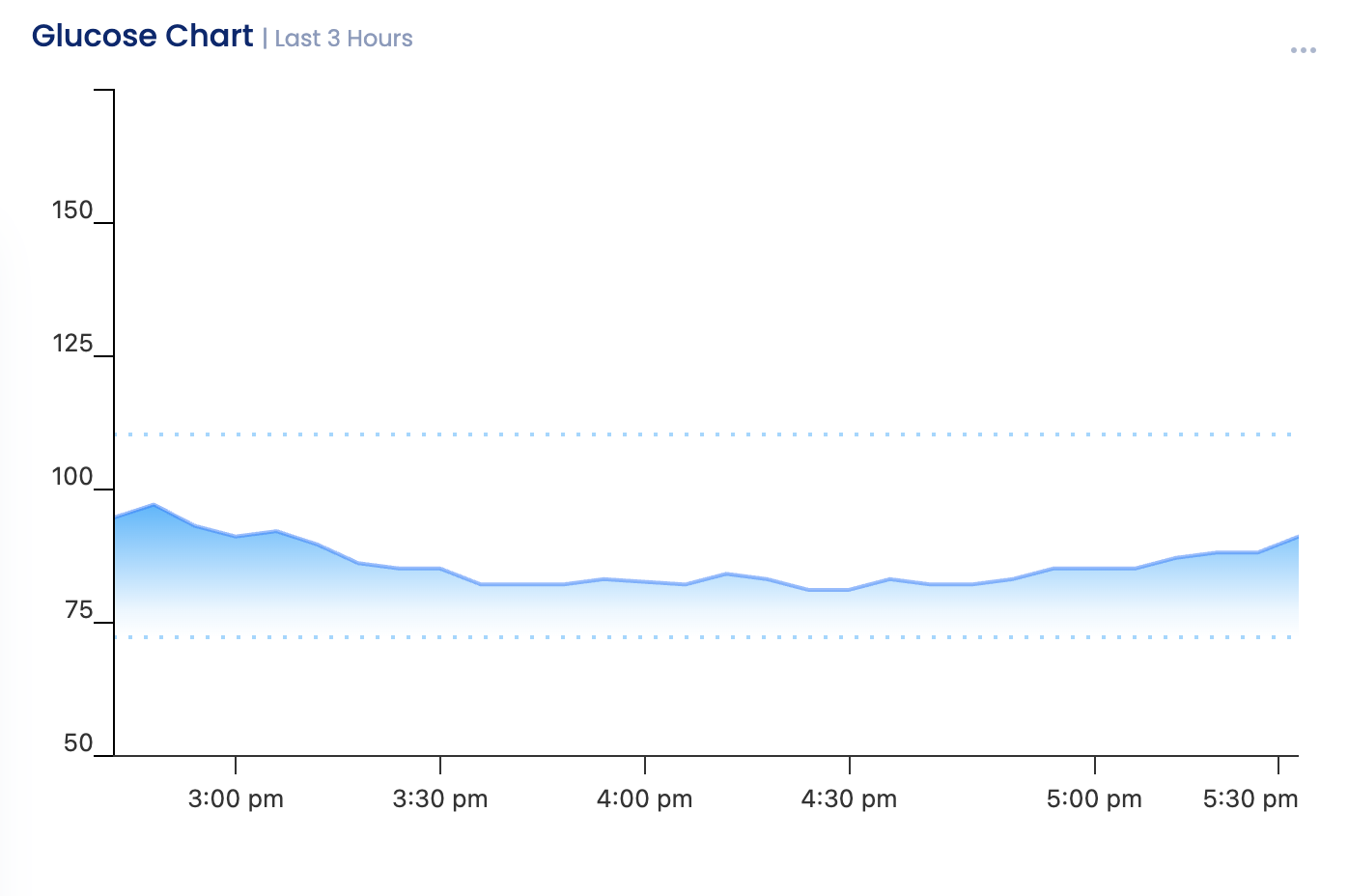
Here's something I've noticed, friend — most of us are visual people. We like seeing our numbers land inside a "normal range" on the screen, not just a raw number floating there. But it matters where that range actually comes from.
The ranges Theia uses are based on CGM studies of healthy, non-diabetic people. From that research, typical glucose patterns run about 70–140 mg/dL most of the time, with fasting averages around 85–92 mg/dL. Theia's app actually uses a tighter 72–110 mg/dL target range, because that's what the data shows as the most stable pattern in healthy people wearing a CGM. (For people with diabetes, targets are different and should be personalized with a healthcare provider.)
Stelo, by comparison, sets one fixed range — 70–140 mg/dL — for anyone who selects "no diabetes" at setup. That number comes from general population averages, not from what's actually the most stable, optimal pattern.
And here's the thing, friend — "normal" isn't actually the goal. A Tufts University-led study found that only 6.8% of American adults are in optimal cardiometabolic health. That means the "average" American, the one those population ranges are built around, is metabolically unhealthy. If your target range is modeled on what's typical, you're aiming at a moving target that's already off track for most people. That's why "normal" isn't the goal in this program. You're not aiming for a population average — you're finding out where you actually sit on the blood sugar imbalance spectrum, and building a plan personalized to that starting point.
What If My Sensor Fails?
This one's worth mentioning, because it happened to me. The very first time I ever wore a CGM, I bumped my arm on a doorframe and knocked the sensor right off. Theia sent me a replacement, no questions asked. With how much these sensors cost, that's not a small thing — that's real peace of mind while you're mid-program and relying on consistent data.
A Newer Feature Worth Knowing About
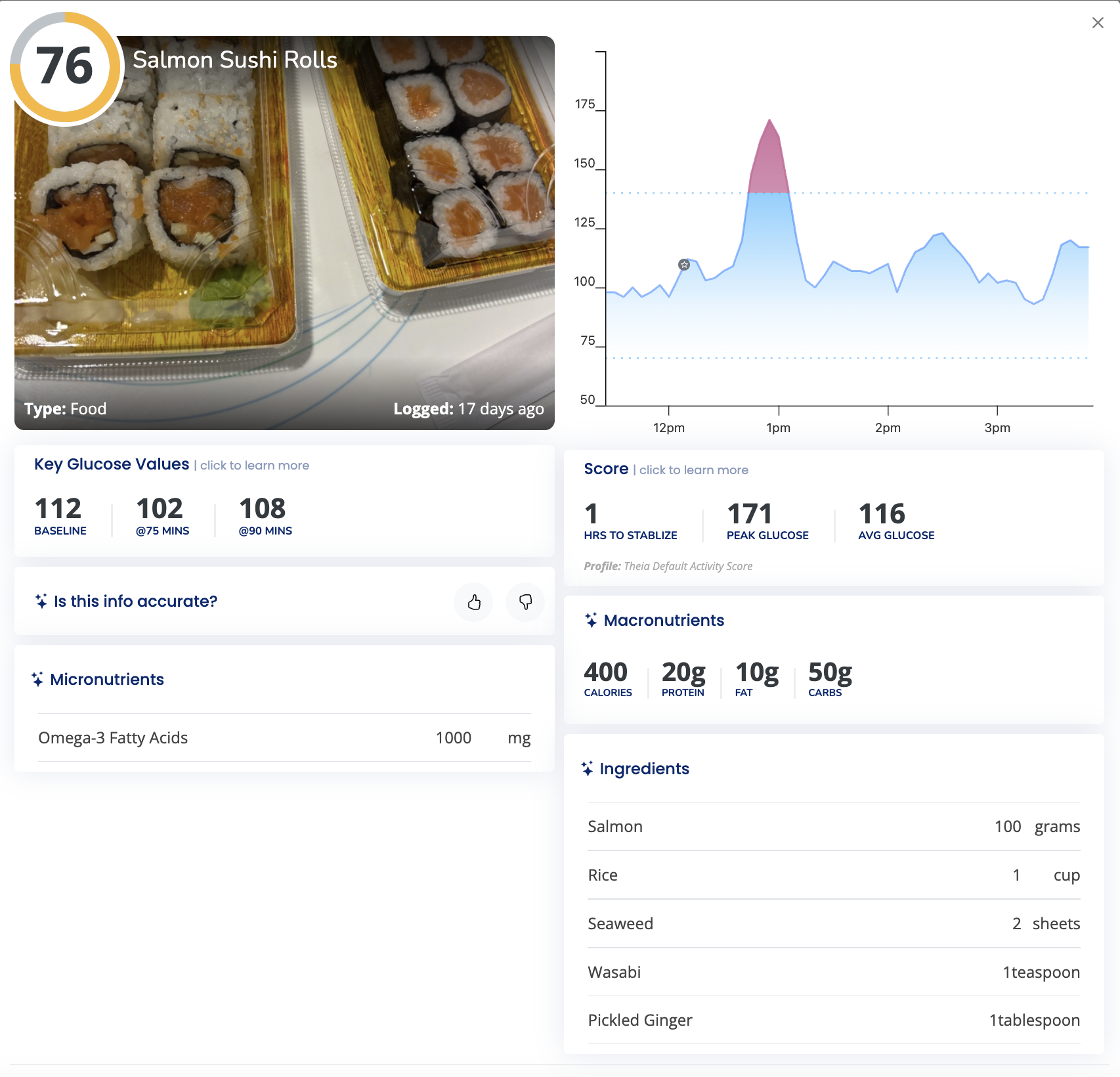
Theia just added AI Nutrition tracking — snap a photo of your meal, and it identifies what's in it, logged right alongside your glucose data. And it's not just meals — Theia lets you track a much wider range of what actually affects your blood sugar: supplements, activity, sleep, stress, even things like when you took your medication. Stelo's tracking is far more limited by comparison, mostly just food.
To be clear: we don't count calories or chase macro targets in Insulin Insight. That's not how lasting change happens here. What this feature is good for: no more guessing what you ate that caused that spike. Your meal's logged automatically, sitting right next to your glucose curve. It's a tool for seeing your patterns more clearly, not for tracking numbers to hit.
Can You Actually See Your Trends?
Here's one that matters a lot for this program specifically, friend: in Insulin Insight, we compare trends over time. That means you need to actually be able to see those trends happening, not just today's number.
This is where Stelo runs into a real limitation. As of their most recent app update, Stelo only keeps a rolling 24 hours of detailed data — after that, older readings collapse into hourly averages you can't drill back into. If you want your full history, you have to go to a separate site and log in again just to look back. For a program built around watching your patterns unfold over days and weeks, that's a real drawback, not a minor inconvenience.

The Bottom Line
Counting calories tells you what you ate. A CGM tells you what your body actually did with it. That's insulin insight.
Both options can technically show you a glucose trend. But if you're doing the work of actually changing your patterns — not just observing them from a distance — the accuracy and support behind a clinical-grade CGM is what makes that work possible. That's why Theia is the CGM we recommend inside Insulin Insight for Midlife Weight Loss.
Questions about which CGM is right for you, friend? Ask me.